Showing posts with label Kindergarten Class Set Up. Show all posts

Saturday, August 18, 2018

Creating Our Kindergarten World - Setting Up a Classroom that Inspires

Science Museum - 2018/2019
How can I possibly be setting up my classroom for the 29th time? Those first years just blur together in a haze of bulletin board paper and stacks of boxes. In those beginning years, my classroom looked very much like the ones I had lived in as a child. The desks in rows, teacher’s desk at the front. (Being a cop’s wife, I always put mine at the back so I could keep my eye on everything in front of me!)

I laugh when remembering my second school, an open school built in the 70’s. We tried to create walls from furniture, searching for our classroom boundaries in the midst of those wide-open spaces. I vaguely remember a child disappearing through our “walls” now and then!

But, since 1999 when inquiry teaching took over my heart and soul, my room setups don’t look quite like they used to. Our kindergarten feels sort of like a little village of specialty areas where kids can find their place - what drives them, what moves them, what they care about. Or where they can even help to create their own space.
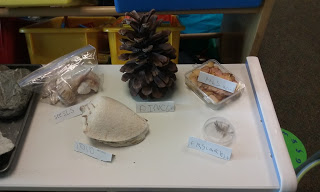
Closeup of Science Museum - 2016
with child-made labels on their artifacts
My teaching heart now rests on creating invitations for young scientists, artists, social scientists, mathematicians, readers and writers to envision the world and their work in it. Thank God for my teaching assistant, an artist at heart, who helps me figure out the mechanics of bringing our dreams to reality.
Atelier - 2016
How do we make our room come to life?
Library Organized by the Children - 2017/2018
  • First, we consider the big picture, the spaces we can’t imagine living without. For us, it’s an Atelier (artists’ workshop), Science Museum, Construction Zone (blocks), library, and constantly-evolving dramatic play area.
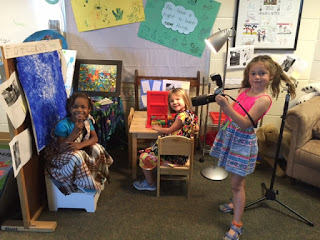
    Dramatic Play Area transformed from a
    home to a photography studio, 2016
  • Next, we envision the whole group teaching area (complete with big book stand, authentic calendar work, Smart Board access and room to spread out.)
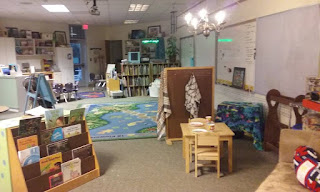
    View from the door - 2016 across the dramatic play area,
    looking toward the whole group teaching area
  • View from reverse of whole group teaching area - 2016,
    looking back toward children's cubbies and shelving
  • Then, we think about our upcoming inquiries and the specialty areas where we envision kids living through different perspectives. We embark on photography early in kindergarten around the time our school pictures are taken.
    • We take photos of the photographer as he’s taking pictures of us. We know that shortly our dramatic play area will become a photography studio and check-in office based on his set-up.
    • Our walls will display children’s photos.
    • Our science museum will burst with old cameras, negatives, and film reels.
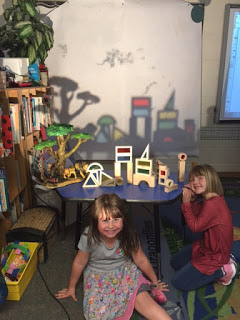
      Shadow Wall - 2016
  • Finally, we reflect on other desired areas: a Color Studio for artists, Shadow Wall for builders, Authors’ Hangout for writers, a Tech Zone for engineers, and an office for mathematicians. We are thrilled to have a large porch and beautiful garden just outside our backdoor - perfect for naturalists, gardeners, poets and painters.
  • Oh, I almost forgot those long work tables with chairs to squeeze in…
  • Most importantly though, we invite the children to move into the spaces and make them their own! We encourage brainstorming and accept their ideas. When youngsters feel that they own the room, their work becomes even more transformative.
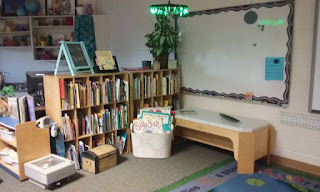
    Lights & Shadows Setup - 2016
    Light table & overhead projector amidst books

My biggest suggestions
1. Put in first those things that compel you!
2. Then, think of places in which your children can engage.
3. Last, squeeze in what else you need.
4. However, once the children arrive, be open to their involvement in creating your world together.

If you find it difficult to imagine giving some control over to your students, consider this: One of my brave colleagues actually puts her furniture in the middle of the room for the children to negotiate their classroom together! Those children truly own the space and all their work that happens in it. 

Disclaimer: Whatever you do, be open to the
children's ideas for transforming their own space!

What are your primary considerations when creating your ideal classroom? Please feel free to share photos, too, so we can learn from each other.

Friday, March 23, 2018

What a Kindergarten Looks Like


My question: “What draws you to choose a book? Do you flip through it? Look at the cover? Read the book jacket?”
Sweet Sally declares, “Bekus it is the tim.
Her mom asked her what that meant. “Because it is the time,” she shared. “I chose to read ‘The Block Party’ because yesterday I went to a birthday party.” She shrugged her shoulders and smiled.

Intriguing thoughts coming from a five-year-old, aren’t they? Rather than giving a traditional response we might expect, Sally embraced the question with her open-minded approach to life. Her simple answer took me off guard.

Yet, it made such sense! Sally’s reflection propels my similar, simple thinking about what my K/1 classroom should look like. Of course, our room should look like our “times” and our calendars as well as our curriculum, interests and passions. Beyond picture book covers, our writing samples and work spaces should be overflowing with our current content.

*If we’re studying plants, we should collect and sort specimens, living and learning as botanists.
*If we’re studying three-dimensional shapes, we should manipulate geometric shapes and build structures, living and learning as architects.  
*And, if we’re studying photography, we should question and observe, live and learn as photographers do.Through taking on these different perspectives, children’s awareness grows. They truly feel a need to know information related to their discipline. Learning about botany, architecture or photography becomes an authentic and valued part of our lives – and the lives of our families.


A Closer Look at One Unit of Study - Photography -
& How It Impacts Our Classroom Appearance
*Even as we teach reading, we learn to read about “how to take pictures” through nonfiction books on photography. As we flip pages in picture books or books using photography for illustrations, we notice the compelling moves illustrators make.
*While we practice writing concepts, we describe the lives of notable photographers or their typical subjects to photograph. We see ourselves as illustrators - trying out different ideas we’ve culled from inspiring books. Both collaborative books designed by the whole class and individually-crafted books reflect our growing knowledge and interest.
*Math skills of counting money, scheduling appointments and organizing data are evident in engaging ways at our photography studio and later, in our photo booth. Cash registers, appointment books, calendars and organizers flow from the dramatic play area. (One perfect, authentic observation is on School Picture Day where children observe the photographer in action, the set-up, equipment, even the footprints taped to the floor! Taking photographs of the photographer at work propels substantive talk later.)

*In the science museum, cameras, film reels, negatives and a light table draw children over alongside sketch pads and magnifying glasses. Science & social studies abound in nonfiction books, child-made posters, class journals and children’s writings. Such topics include:
        +The history of cameras
        +Lives of famous photographers (Ansel Adams, Snowflake Bentley)
        +How cameras work
        +How-to narratives on ‘using different features on cameras”
*Perhaps the most significant touchstone of this study is the children’s real work as photographers themselves. Daily in the morning meeting, we showcase and talk about a photograph from a professional photographer. As children build on their understandings, we apprentice ourselves to our teacher assistant/photography expert, observing her and then being guided as we take our own photos at school. Of course, before we know it, children are taking photos at home and sending them via email to show on our large white board. We begin focusing on our individual work as photographers and how each of us is growing and changing. At each child’s turn as “photographer of the day,” they showcase their work, commenting on the moves they made as they created their snapshots. Sally and her friends are continually inspiring other classmates to broaden their own work.


You can imagine how the room begins changing as the content deepens. When teachers teach reading, writing, math and more by immersing their learners in rich study (of plants, architecture, photography or whatever), authentic questions arise. These questions result in more artifacts brought from homes, more noticings in the real world, and more awareness of the subject through technology and more authentic learning. Of course, these burgeoning resources fill our classroom devoted to such in-depth studies. So, just as Sally enlightened us all because it was the time, we are surely changed as readers, writers, thinkers, creators, historians, scientists and photographers.


As one unit of study concludes, the room begins changing again… Can you guess what our next inquiry will be?

Please share an example of a study that has changed your world.